
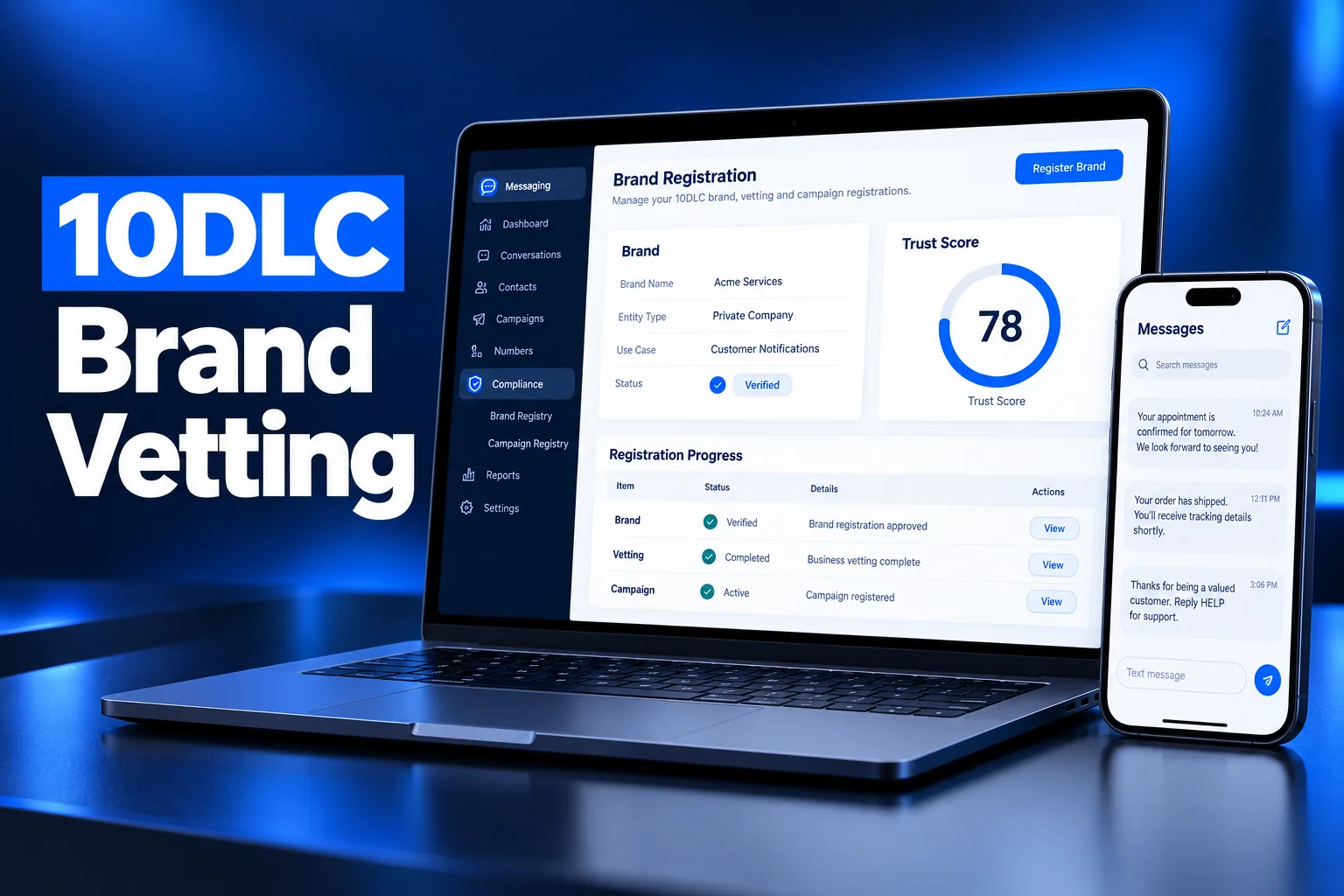
10DLC brand vetting is the extra review of your business that produces a Trust Score from 0 to 100. That score sets how fast your registered 10DLC numbers can send and how many messages a day T-Mobile accepts from your brand. On Twilio, secondary vetting runs automatically for Standard Brands and costs a $41.50 pass-through fee.
This guide explains what brand vetting checks and how the Trust Score maps to throughput and daily limits. It also covers what causes a low score, what vetting costs and when a re-vet or appeal is worth it.
What is 10DLC brand vetting?
10DLC brand vetting is a reputation review of the business behind an A2P 10DLC brand registration. After The Campaign Registry (TCR) verifies the brand, secondary vetting scores it from 0 to 100. That Trust Score decides the brand’s message throughput and its T-Mobile daily message limit.
There are two separate checks in A2P 10DLC, and people often mix them up:
- Brand vetting (secondary vetting): scores the business itself. It happens once per brand and produces the Trust Score.
- Campaign vetting: a manual review of each campaign (use case, sample messages, opt-in flow). It decides approval or rejection, not throughput. See our guide to 10DLC campaign types for how use cases are reviewed.
Brand vetting is part of the wider 10DLC brand registration process, which covers the legal name, EIN, address and website details you submit first.
Which brands get vetted, and which skip it?
Only Standard Brands go through secondary vetting and receive a Trust Score. Low Volume Standard Brands skip it to save the fee, and Sole Proprietor brands are never vetted. Brands without a score get fixed, low throughput set by their brand type and use case.
| Brand type | Secondary vetting | Trust Score | T-Mobile daily limit |
|---|---|---|---|
| Standard Brand | Yes, automatic on Twilio ($41.50) | 0 to 100 | 2,000 to 200,000 per day, based on score |
| Low Volume Standard Brand | Skipped | None | 2,000 per day (200,000 for Russell 3000 companies) |
| Sole Proprietor | None | None | 1,000 segments per day |
A Low Volume Standard Brand can be vetted later. Twilio applies vetting manually on request and charges the standard vetting fee at that point. If you are unsure which type fits, compare them in our guide to sole proprietor vs standard brands.
How does the Trust Score affect throughput and daily limits?
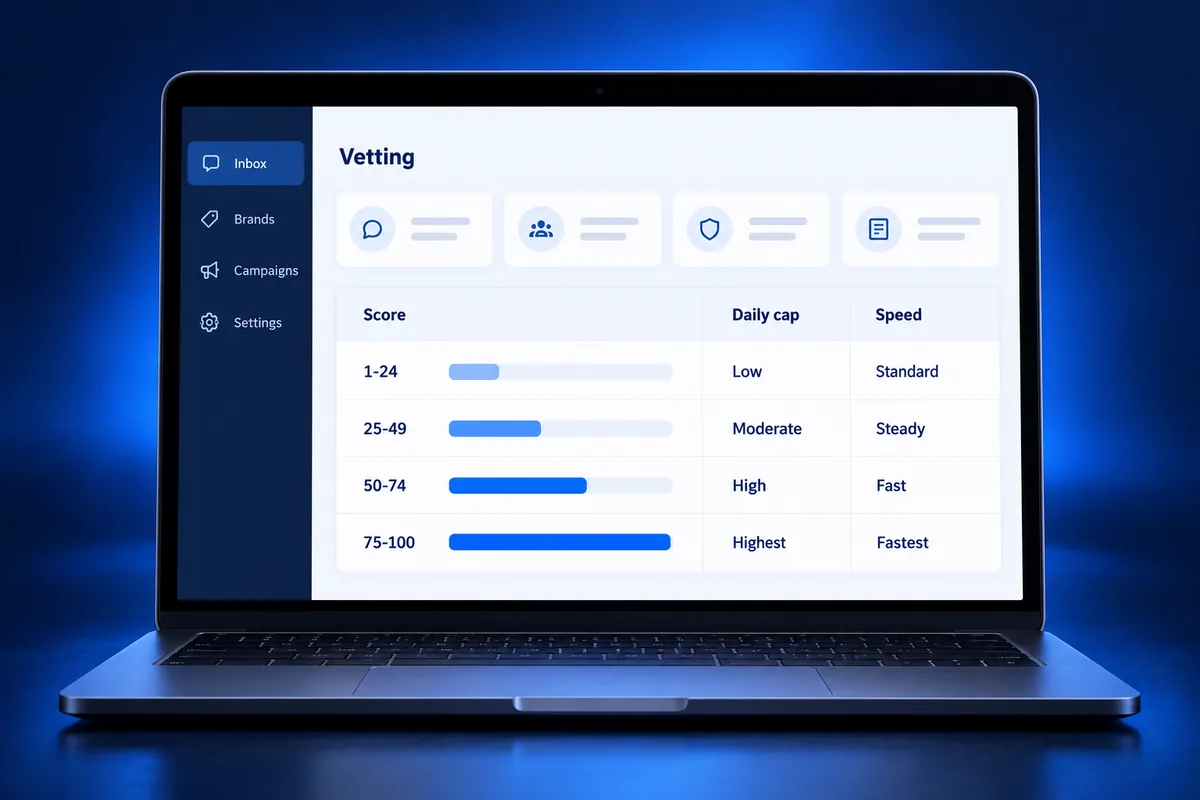
A higher 10DLC Trust Score gives more messages per second (MPS) per campaign and a higher T-Mobile daily cap for the brand. Scores of 75 to 100 get the top tier. Scores below 50 get the same low throughput as an unvetted brand, with daily caps that still differ by score band.
Twilio publishes these tiers for standard campaign use cases:
| Trust Score | MPS per major carrier (AT&T, T-Mobile, Verizon) | Total SMS MPS | T-Mobile daily limit (brand level) |
|---|---|---|---|
| 75 to 100 | 75 | 225 | 200,000 |
| 50 to 74 | 40 | 120 | 40,000 |
| 25 to 49 | 4 | 12 | 10,000 |
| 1 to 24 | 4 | 12 | 2,000 |
Three details trip businesses up:
- The T-Mobile cap is per EIN. It is shared across every brand and campaign registered under that tax ID, even on different platforms. Going over it returns error 30023, and the counter resets at midnight Pacific time.
- Low Volume Mixed campaigns stay slow. That campaign type is fixed at the lowest tier whatever your score.
- Special use cases ignore the score. Throughput for special use cases is not driven by the Trust Score.
Above 200,000 a day, T-Mobile requires a separate Special Business Review.
What raises or lowers a 10DLC Trust Score?
A 10DLC Trust Score drops mainly because of data mismatches between your registration and official records, and because of a small business footprint. Smaller and newer organizations with little public presence usually score lower, even when nothing is wrong with their registration.
Common causes of a low score
- Name mismatch: the legal business name doesn’t match the IRS record for the EIN exactly, including suffixes like LLC or Inc.
- Address mismatch: the address differs from the one tied to the EIN registration.
- Wrong entity type: for example, registering a sole proprietorship as a private company.
- Thin footprint: a new business, no matching website domain or little public information.
- Website problems: a site that doesn’t show the same business name, or a placeholder page.
What to check before you submit
- Copy the legal name exactly as it appears on your IRS CP 575 or 147C letter. Our EIN verification tool helps you check it.
- Use the address on file for that EIN, not a mailing or virtual office address that differs from it.
- Use a business email on your own domain and a live website that names the same business.
- Pick the entity type and industry that match your official records.
Many brand rejections come from the same mismatches. Our page on brand identity rejections covers the fixes field by field.
How much does 10DLC brand vetting cost?
On Twilio, 10DLC secondary vetting costs $41.50, which brings a Standard Brand registration to $46 in total. It is a one-time pass-through fee per brand. Low Volume Standard Brands skip it and pay only the base brand fee, but accept lower limits.
- ISVs and agencies: each secondary (client) brand registered as a Standard Brand is vetted and charged $41.50.
- Later vetting: a Low Volume Standard Brand vetted later pays the standard vetting fee at that time.
- Campaign vetting is separate: each campaign has its own one-time review fee plus a monthly campaign fee.
Other providers pass these carrier and TCR costs through differently, so check your platform’s price list. Our breakdown of A2P 10DLC fees lists every brand, vetting and monthly cost in one place.
When is re-vetting or an appeal worth it?
Re-vetting or appealing a 10DLC Trust Score is worth it when the low score comes from a data error you can fix. It also pays off when your daily volume will exceed the limit of your current tier. Trust Scores are static, so they don’t rise on their own over time.
| Situation | Worth an appeal? | Why |
|---|---|---|
| Name or address didn’t match the EIN record | Yes | Fix the brand details first, then ask for a re-review |
| Score 1 to 24 and you need more than 2,000 T-Mobile messages a day | Yes | The next band raises the cap to 10,000 |
| Score 25 to 49 and you need more speed | Often | Only 50+ raises MPS above the base tier |
| Score already fits your daily volume | No | A higher score adds nothing you would use |
| New business with a small footprint, data all correct | Rarely | The score reflects footprint, not an error |
On Twilio, appeals go to its 10DLC onboarding team with your account details, and a US brand appeal usually needs the IRS EIN letter. Sending the letter with the first request speeds things up. Other platforms route appeals through their own support.
Stuck with a low Trust Score or a rejected brand?
Did your brand come back with a low score, fail vetting or keep getting rejected? The cause is usually a detail in the registration rather than your business. Finding and fixing that detail before you resubmit saves both fees and another round of review.
A2P Ready checks your brand details against your official records before anything is submitted. See our A2P registration pricing, or browse more A2P 10DLC guides first.
Frequently Asked Questions
What is a good 10DLC Trust Score?
A 10DLC Trust Score of 75 to 100 is the top tier. It allows 75 messages per second per major carrier and a 200,000 per day T-Mobile limit. A score of 50 to 74 is good for most small and mid-size senders. Below 50, throughput drops to the base tier, so most businesses aim for 50 or higher.
How long does 10DLC brand vetting take?
Secondary vetting on Twilio runs automatically during Standard Brand registration and adds no extra approval time on its own. Campaign review is the slower step. Twilio’s help center currently notes campaign reviews taking several days because of high submission volume, so plan for the campaign stage rather than the vetting.
Does a 10DLC Trust Score change over time?
No, a 10DLC Trust Score is static and does not change on its own as your business grows. To change it, you need to correct any wrong brand details and request a re-review or appeal through your messaging provider. Without that, the brand keeps the score it received at vetting.
Is secondary vetting required for 10DLC?
No, secondary vetting is not required. You can register a Low Volume Standard Brand that skips it and pays a lower registration cost. The trade-off is a fixed T-Mobile limit of 2,000 messages a day and the lowest throughput tier. Companies in the Russell 3000 index are the exception.
What happens when I hit the T-Mobile daily limit?
When a brand exceeds its T-Mobile daily limit, further messages to T-Mobile subscribers fail with error 30023 until the limit resets at midnight Pacific time. The limit is shared across all brands and campaigns under the same EIN, so usage on another platform counts toward the same cap.
Do sole proprietors get a Trust Score?
No, sole proprietor brands are not vetted and do not get a Trust Score. They are limited to one campaign, one phone number, 1,000 message segments a day to T-Mobile and low fixed throughput. A business that needs more should register as a Standard Brand with an EIN instead.
