
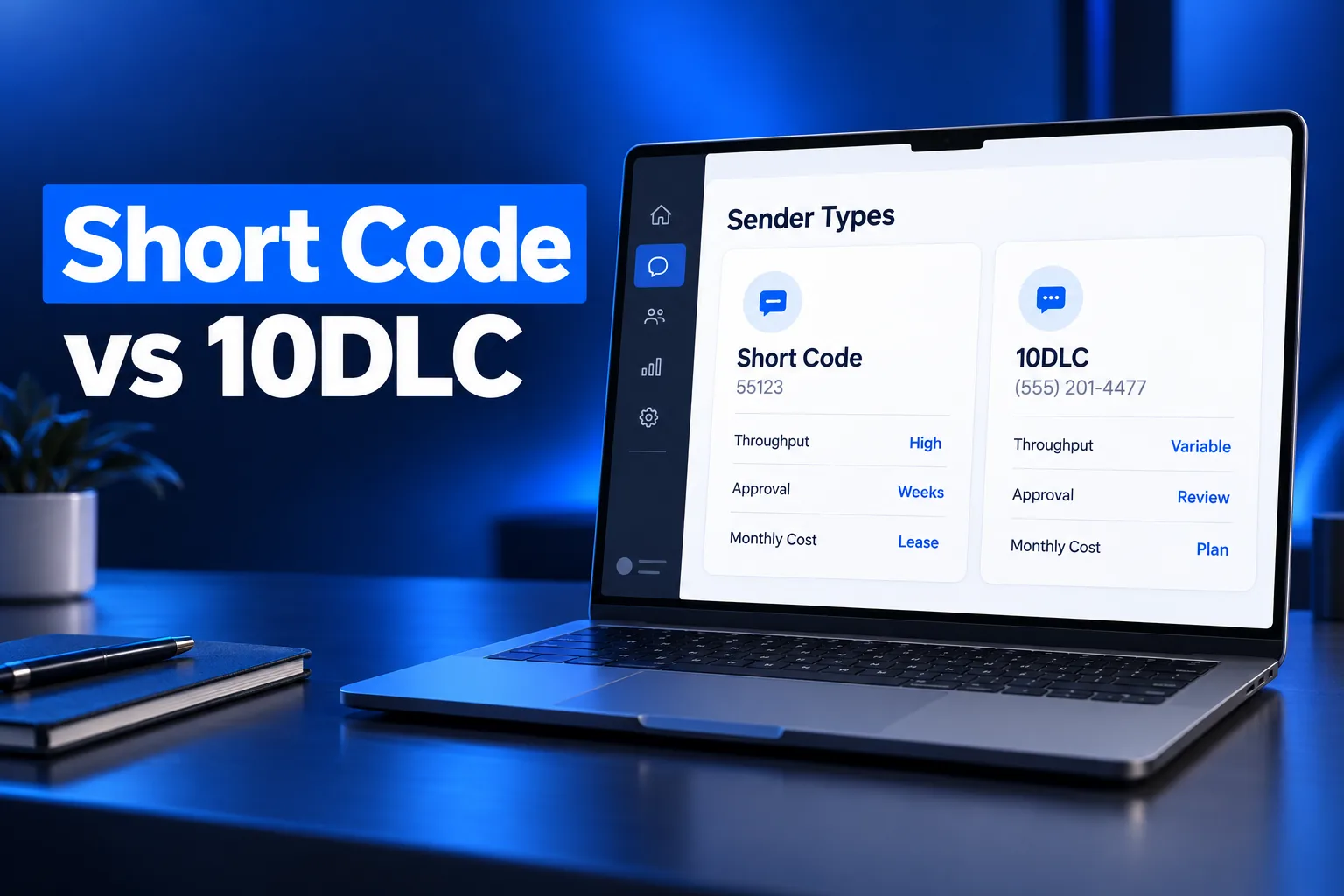
Short code vs 10DLC comes down to volume, budget and time. A short code is a 5 or 6 digit number built for high-volume messaging, but it costs about $1,000 a month to lease and takes weeks of carrier review. A 10DLC number is a regular local number registered for A2P texting. It is cheap, and it fits most small and mid-size businesses.
This guide compares short codes and 10DLC side by side on cost, throughput, approval time and rules. It also covers when a short code is worth it and what changes if you switch later.
What is the difference between a short code and 10DLC?
The difference between a short code and 10DLC is the number and how carriers approve it. A short code is a dedicated 5 or 6 digit number approved program by program by each carrier. 10DLC is a standard 10-digit local number that becomes approved for business texting through A2P 10DLC brand and campaign registration.
- Short code: a number like 55123, leased for one brand and one messaging program. Every US carrier reviews the program before it can send.
- 10DLC (10-digit long code): a local number with a real area code that can also take voice calls. It is approved through The Campaign Registry (TCR), which registers your brand and each campaign.
- Short code vs long code SMS: “long code” is the older name for any 10-digit number. 10DLC is a long code registered for application-to-person (A2P) traffic.
Toll-free numbers are a third option with their own verification process. Our guide to toll-free vs 10DLC compares those two.
Short code vs 10DLC: side-by-side comparison
Short codes win on raw throughput and brand recognition for mass campaigns, while 10DLC wins on cost, setup time and local presence. The table below compares both on the points that decide most choices, using Twilio’s US pricing and guidelines as a reference provider as of October 2026.
| Factor | Short code | 10DLC |
|---|---|---|
| Number format | 5 or 6 digits | 10-digit local number |
| Number cost (Twilio) | $1,000 a month random, $1,500 vanity, billed quarterly, plus a one-time setup fee | $1.15 a month per local number |
| Registration | Short code application reviewed by each carrier | Brand and campaign registration through TCR |
| Approval time | About 4 to 8 weeks of carrier review after payment (Twilio) | Usually days to a few weeks, mostly campaign review |
| Throughput | 100 messages per second by default | Set by brand Trust Score and carrier, from a few to 75 per second |
| Daily limit | No brand-level daily cap like 10DLC | T-Mobile daily cap per EIN, from 2,000 to 200,000 based on score |
| Carrier fees per message | Yes, short code surcharges | Yes, 10DLC surcharges |
| Voice calls | No | Yes, same number |
| Best fit | National brands, mass alerts, big promos | Small and mid-size businesses, local and two-way texting |
Prices and limits vary by provider. Check your own provider’s current rates before you budget.
How much does a short code cost compared with 10DLC?
A short code costs far more than 10DLC. On Twilio, a random short code is listed at $1,000 and a vanity short code at $1,500, billed quarterly with a one-time setup fee. A 10DLC local number is $1.15 a month, plus one-time brand and campaign registration fees and a monthly campaign fee.
Short code costs
- Lease: random or vanity, billed quarterly on Twilio. A vanity code is a number you choose, such as one that spells a word.
- Setup fee: a one-time fee on top of the lease.
- Messages: Twilio lists the same base SMS rate for short code, long code and toll-free ($0.0083 per segment outbound in the US).
- Carrier surcharges: on Twilio’s US page, short code outbound fees are $0.0035 for AT&T, $0.0045 for T-Mobile and $0.005 for Verizon per message.
10DLC costs
- Number: a regular local number at a low monthly price.
- Registration: one-time brand registration, optional secondary vetting and a campaign vetting fee, then a monthly campaign fee.
- Carrier surcharges: per-message 10DLC fees set by each carrier.
Our breakdown of A2P 10DLC fees lists each registration and carrier fee. For a business sending a few thousand texts a month, 10DLC usually costs a small fraction of a short code lease alone.
Which is faster: short code or 10DLC?
A short code is faster for bulk sending. Twilio lists short code throughput at 100 messages per second by default. 10DLC throughput depends on your brand’s Trust Score from secondary vetting, ranging from a few messages per second up to 75 per carrier. T-Mobile also caps daily volume per EIN.
| 10DLC Trust Score | Throughput per major carrier | T-Mobile daily cap per EIN |
|---|---|---|
| 75 to 100 | 75 messages per second | 200,000 |
| 50 to 74 | 40 messages per second | 40,000 |
| 25 to 49 | 4 messages per second | 10,000 |
| 1 to 24, or Low Volume Standard (no vetting) | 4 messages per second | 2,000 |
For most businesses, 10DLC throughput is more than enough. A brand at the top tier can send hundreds of thousands of texts a day to T-Mobile alone. Our guide to 10DLC brand vetting and Trust Scores explains how the score is set and how to appeal it.
Throughput only becomes the deciding factor when you must reach a very large list in minutes, such as a flash sale, an emergency alert or a national promotion.
How long does short code approval take vs 10DLC?
Short code approval usually takes longer than 10DLC. Twilio says carrier review of a US short code takes about 4 to 8 weeks after payment, and applications sent from mid-December to early January can be delayed by the carriers’ holiday freeze. 10DLC brand registration is often quick, with campaign review taking days.
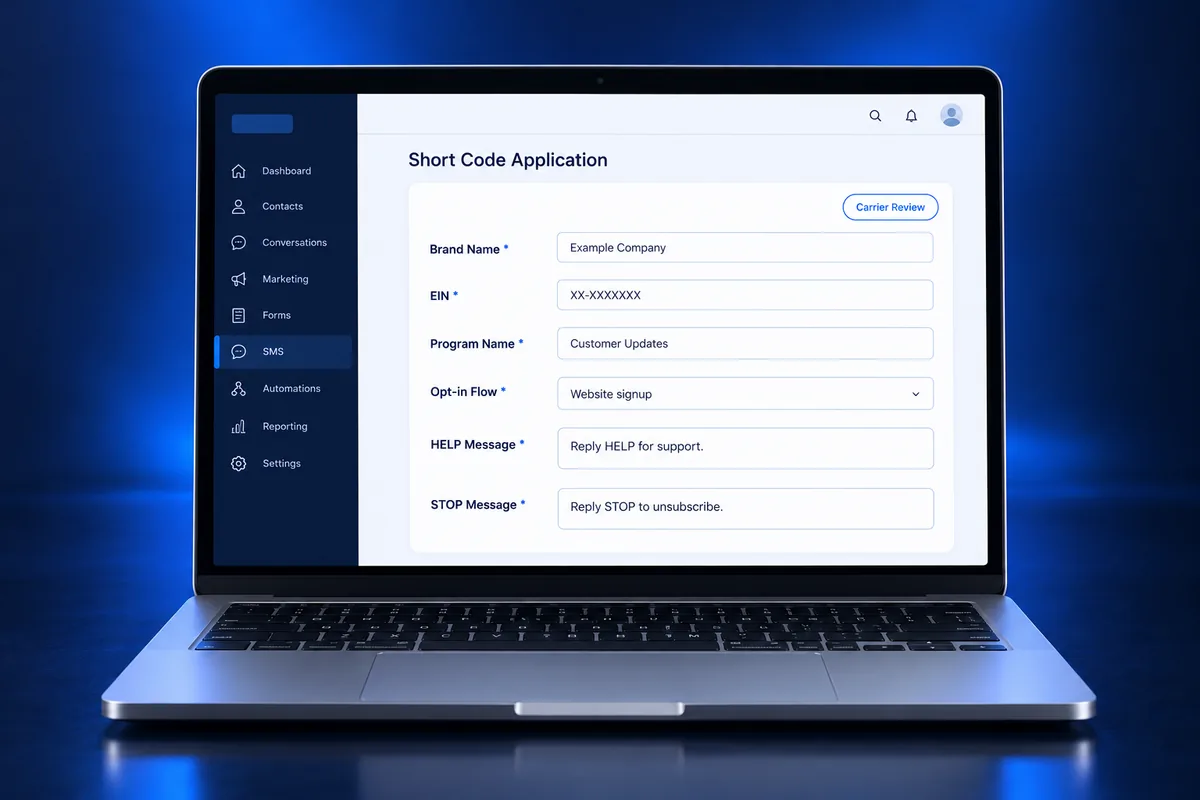
- Short code: the provider reviews your application first, then each carrier approves or rejects it. Carriers can reject any use case even when every requirement is met.
- EIN required: since March 31, 2025, new short code campaigns and renewals must include a valid EIN, and brand details must match IRS records.
- 10DLC: the brand is verified by TCR, then each campaign is reviewed. See our A2P 10DLC approval timeline for what each stage takes.
If you need to start texting this month, 10DLC or toll-free is the realistic choice. A short code needs planning a quarter ahead.
What rules apply to short codes and 10DLC?
Short codes and 10DLC follow the same core consent rules: express opt-in before the first message, clear program details and working HELP and STOP keywords. Short codes add stricter program rules. One short code must be controlled by a single entity, and some use cases are banned or slower to approve.
- Consent: both need documented opt-in. Our guide to SMS opt-in language shows what carriers look for.
- Single entity: Twilio’s guidelines say a short code cannot be shared across independent businesses. 10DLC numbers are also tied to one registered brand.
- Banned on short codes: Twilio lists sexual content, gambling, debt collection and lead-generation programs among use cases short codes do not support.
- Slower to approve: age-restricted content, sweepstakes and direct lender loan programs.
- Industry rules: CTIA’s Short Code Compliance Handbook sets the program rules for short codes, and the CTIA Messaging Principles apply to 10DLC.
Carrier rules are not legal advice. Confirm consent and state texting rules with your counsel before launch.
Should you use a short code or 10DLC?
Most businesses should use 10DLC. Choose a short code only when you send very large volumes in short bursts, run national campaigns where a memorable number matters, and can pay a lease of about $1,000 a month while waiting weeks for approval. Everyone else gets better value from 10DLC.
| Your situation | Best fit |
|---|---|
| Local business texting customers and leads | 10DLC |
| Two-way conversations and calls on one number | 10DLC |
| Agency running many client brands | 10DLC, one brand per client |
| National retailer sending flash sales to a huge list | Short code |
| Text-to-join keywords in TV or radio ads | Short code |
| Need to send this week, no EIN-based brand yet | Toll-free or sole proprietor 10DLC |
Many large senders use both: a short code for mass marketing and 10DLC numbers for one-to-one conversations with customers.
Can you switch from 10DLC to a short code later?
Yes, you can move from 10DLC to a short code later, but it is a new program, not an upgrade. You lease the code, submit a full short code application and wait for carrier approval. Your opted-in list can usually move if your consent language covered the brand and program, not just one number.
- Keep consent portable: write opt-in language around your brand and message type, so the consent still applies on a new number.
- Tell subscribers: announce the new number from the old one so replies and STOP requests are not lost.
- Keep 10DLC running: most businesses keep their 10DLC numbers for two-way texting after a short code goes live.
Not sure which sender type fits your program?
Picking the wrong sender type costs months. A short code that was never needed wastes the lease, and a rejected 10DLC campaign stalls every text you planned to send. Getting brand details, campaign type and opt-in flow right the first time is what saves the time.
A2P Ready prepares and submits 10DLC and toll-free registrations for you. If you have already been rejected, see how we fix rejected A2P campaigns, or check our registration pricing. For the full picture of how registration works, start with our A2P 10DLC guide.
Frequently Asked Questions
Is a short code better than 10DLC?
A short code is better than 10DLC only for very high-volume senders. It sends 100 messages per second by default and suits national campaigns, but it costs about $1,000 a month on Twilio and takes weeks to approve. For local businesses and two-way texting, 10DLC is cheaper, faster to launch and fast enough.
How much does a dedicated short code cost?
A dedicated short code on Twilio costs $1,000 for a random code or $1,500 for a vanity code, billed quarterly, plus a one-time setup fee. Bringing your own vanity code is $500. On top of that you pay per-message SMS rates and carrier surcharges. Other providers price short codes differently, so compare before you apply.
Do short codes need A2P 10DLC registration?
No, short codes do not need A2P 10DLC registration. They go through their own short code application, which each carrier reviews. Since March 31, 2025, that application must include a valid EIN that matches IRS records. A2P 10DLC registration through The Campaign Registry applies only to 10-digit local numbers.
Can a short code receive replies?
Yes, a short code can receive replies, and it must answer HELP and STOP keywords once approved. That is how text-to-join keywords work. A short code cannot make or take voice calls, though, so businesses that want calls and texts on one number usually choose a 10DLC local number instead.
What is the difference between short code and long code SMS?
Short code SMS is sent from a 5 or 6 digit number approved for one program by each carrier. Long code SMS is sent from a standard 10-digit number. In the US, a long code used for business texting must be registered as A2P 10DLC, which sets its throughput and daily limits through the brand’s Trust Score.
Can an agency share one short code across clients?
No, an agency cannot share one short code across independent client businesses. Twilio’s guidelines say all short code messaging must be controlled and vetted by a single entity. Agencies texting for several clients should register each client as its own 10DLC brand with its own campaigns and numbers.
