
SMS Consent Laws and Requirements
Federal law and carrier rules govern business texting. Here is a plain overview of what consent means for your messages. This is general information, not legal advice.
What SMS Consent Laws Mean for Texting
In the US, the TCPA sets consent rules for many business texts. Carriers add their own rules through the CTIA Messaging Principles and Best Practices. Customers should agree before you text them, and marketing texts generally need written consent. People must be able to opt out at any time, for example by replying STOP.
Which rules apply to business texts?
In the US, the Telephone Consumer Protection Act (TCPA) sets consent rules for many business texts. Carriers apply their own requirements too, including the CTIA Messaging Principles and Best Practices.
Do I need consent before texting?
Yes. Customers should agree to receive your texts before you send them, and marketing texts generally need stronger, written consent.
How should opt outs work?
Customers must be able to opt out at any time, for example by replying STOP, and you should stop messaging them when they do.
Is this legal advice?
No. This is general information. Speak with a qualified attorney about your specific situation.
What Do the TCPA Rules Say About Business Texts?
Under the TCPA, marketing texts sent with automated systems generally need prior express written consent, and people must be able to revoke consent easily. Two recent changes matter. A federal court vacated the FCC one-to-one consent rule in January 2025, and the FCC delayed its “revoke-all” rule to January 31, 2027. This is general information, not legal advice.
| Rule | Status (October 2026) |
|---|---|
| Prior express written consent for marketing texts | In force. |
| One-to-one consent rule | Vacated by the 11th Circuit on January 24, 2025. |
| Revoke-all rule (one opt-out covers all message types) | Delayed to January 31, 2027; under FCC reconsideration. |
| Federal calling hours | 8 a.m. to 9 p.m. recipient local time. |
Confirm with counsel for your situation.
Which State Texting Laws Are Stricter?
Some states add their own rules on top of the TCPA. Florida and Oklahoma limit marketing texts to 8 a.m. to 8 p.m. recipient local time, and to three messages on the same subject in 24 hours. Texas added texting to its telemarketing registration rules from September 1, 2025. Check each state you text into.
- Florida (Telephone Solicitation Act, amended 2023): 8 a.m. to 8 p.m., at most 3 same-subject messages per 24 hours.
- Oklahoma (Telephone Solicitation Act, effective November 1, 2022): same window and limit.
- Texas (SB 140, effective September 1, 2025): texting covered by telemarketing registration rules.
A safe multistate practice is 8 a.m. to 8 p.m. in the recipient’s local time. These summaries come from state-law trackers; confirm the statute for your use.
How Do Carrier Rules Add to the Law?
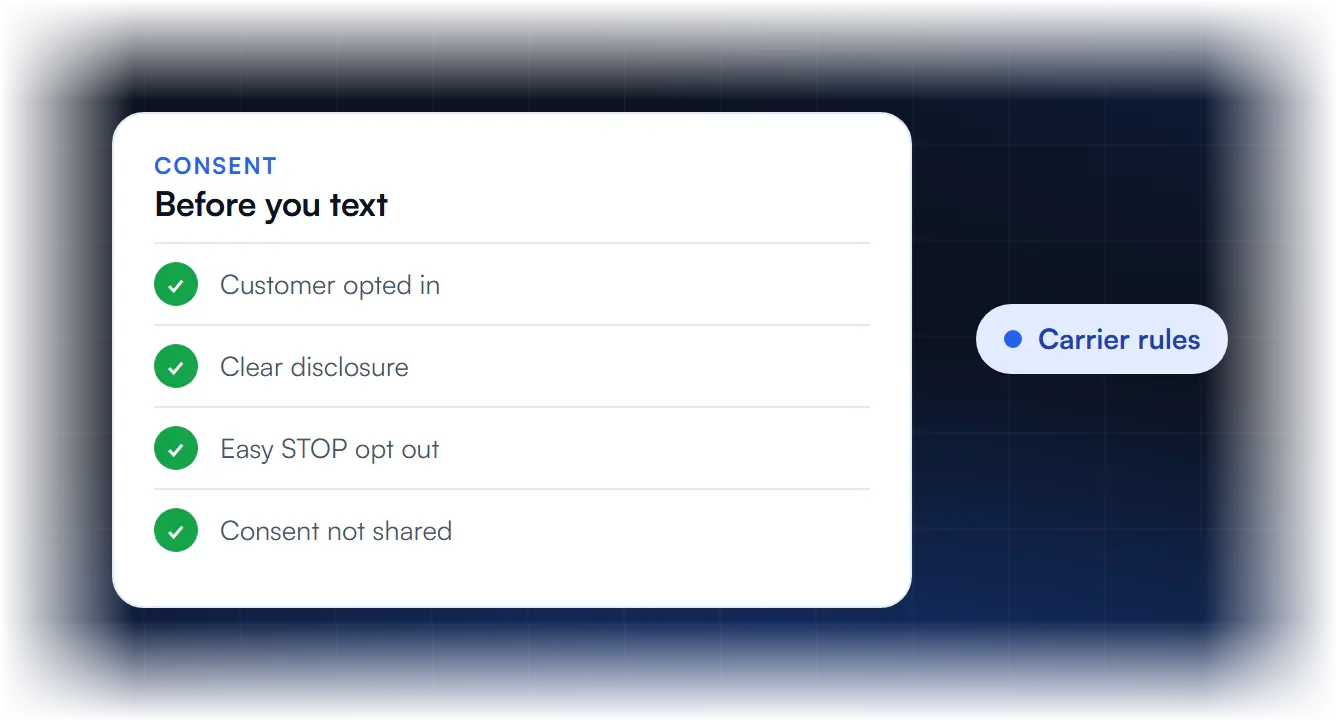
Carrier rules sit on top of the law and build on the CTIA Messaging Principles and Best Practices (May 2023 edition). They require a clear opt-in, honored opt-outs such as STOP, a working HELP reply and no sharing of consent. A2P registration is where carriers check this, so a legal program can still fail review.
- Opt-in: clear, optional, unchecked consent; see SMS opt-in language.
- Opt-out and help: STOP and HELP replies; see errors 30887 and 30890.
- Privacy: no sharing of mobile data; see SMS privacy policy requirements.
- Content: some categories are restricted; see non-resubmittable rejections.
Consent Practices Carriers Expect
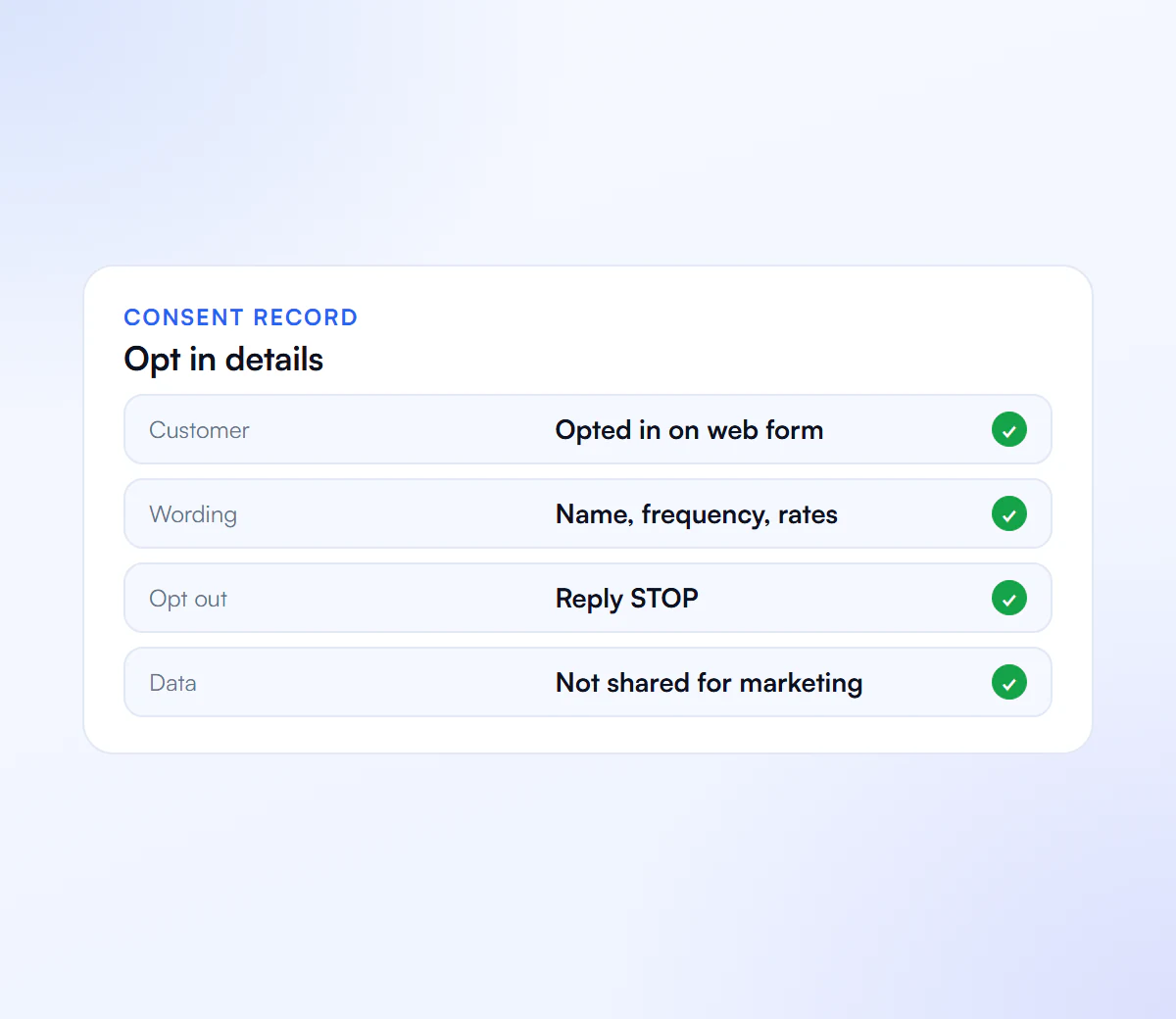
Carriers expect these four consent practices, and they also help your registration pass review. Customers actively agree to your texts. The disclosure says who you are, what you send and how often. Replying STOP works and you honor it. Consent and phone numbers are never shared with other companies for their marketing.
Clear Opt In
Customers actively agree to your texts.
Disclosure
Who you are, what you send and how often.
Easy Opt Out
Replying STOP works, and you honor it.
Data Protection
Consent is not shared for marketing.
We Build a Compliant Flow
We prepare your opt-in wording, disclosures, privacy policy clause and registration so they match carrier rules. Then we write your brand and campaign and submit them to The Campaign Registry. If reviewers ask for changes, we make them. This is practical compliance help for registration, not legal advice on the TCPA or state laws.
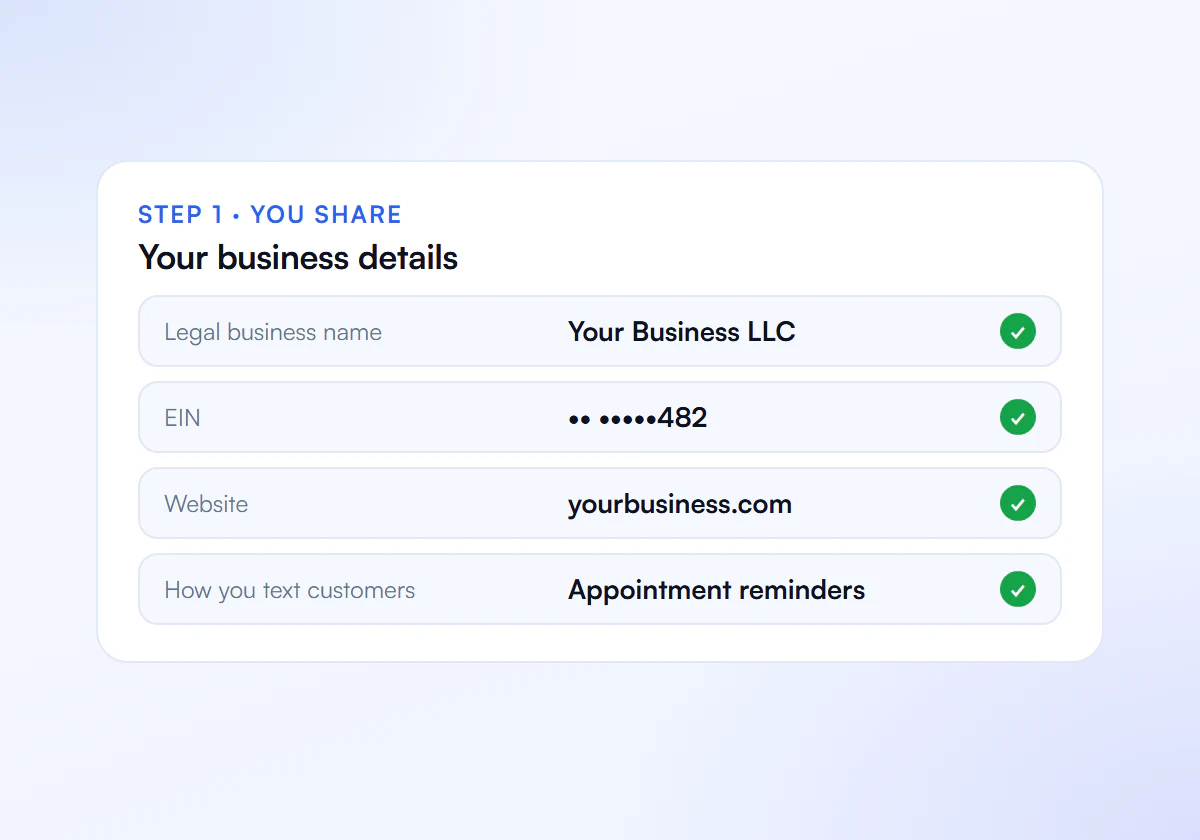
Share Your Details
Send us your business details, website and how you text customers.
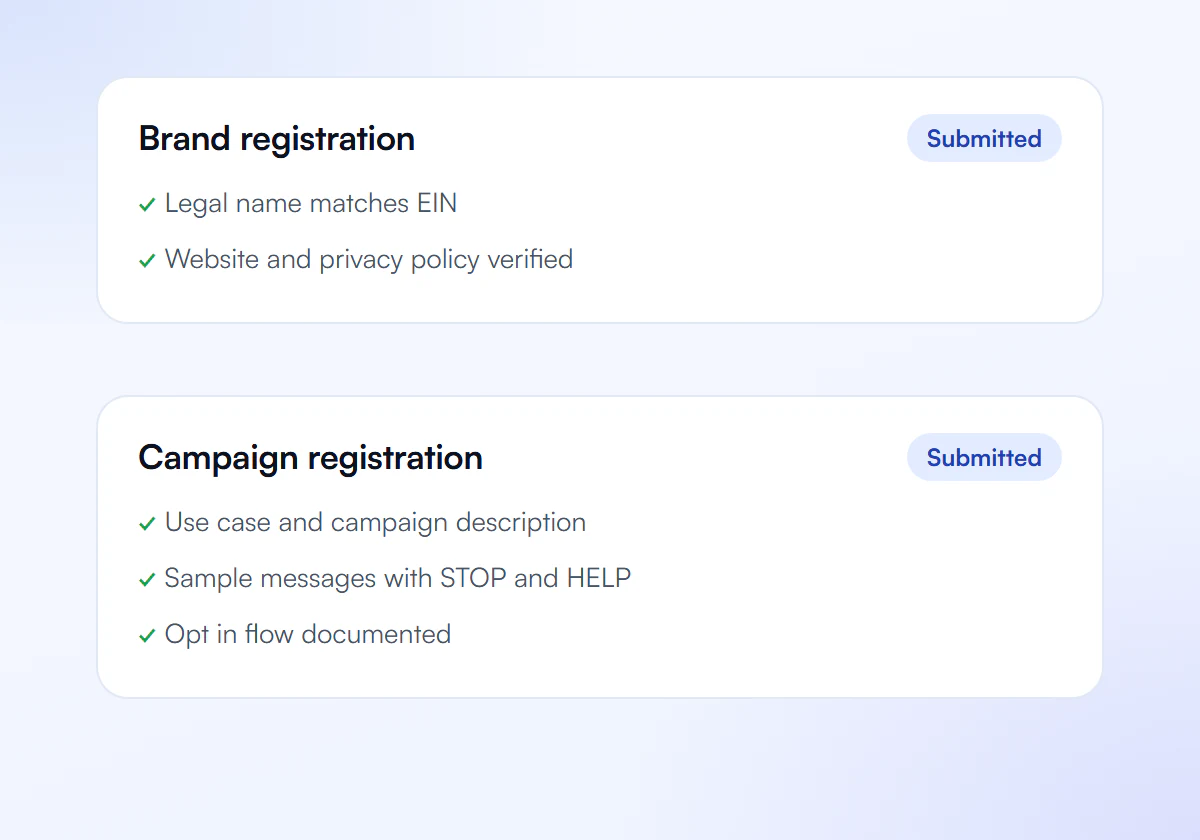
We Prepare and Submit
We write your brand and campaign and submit them to The Campaign Registry.
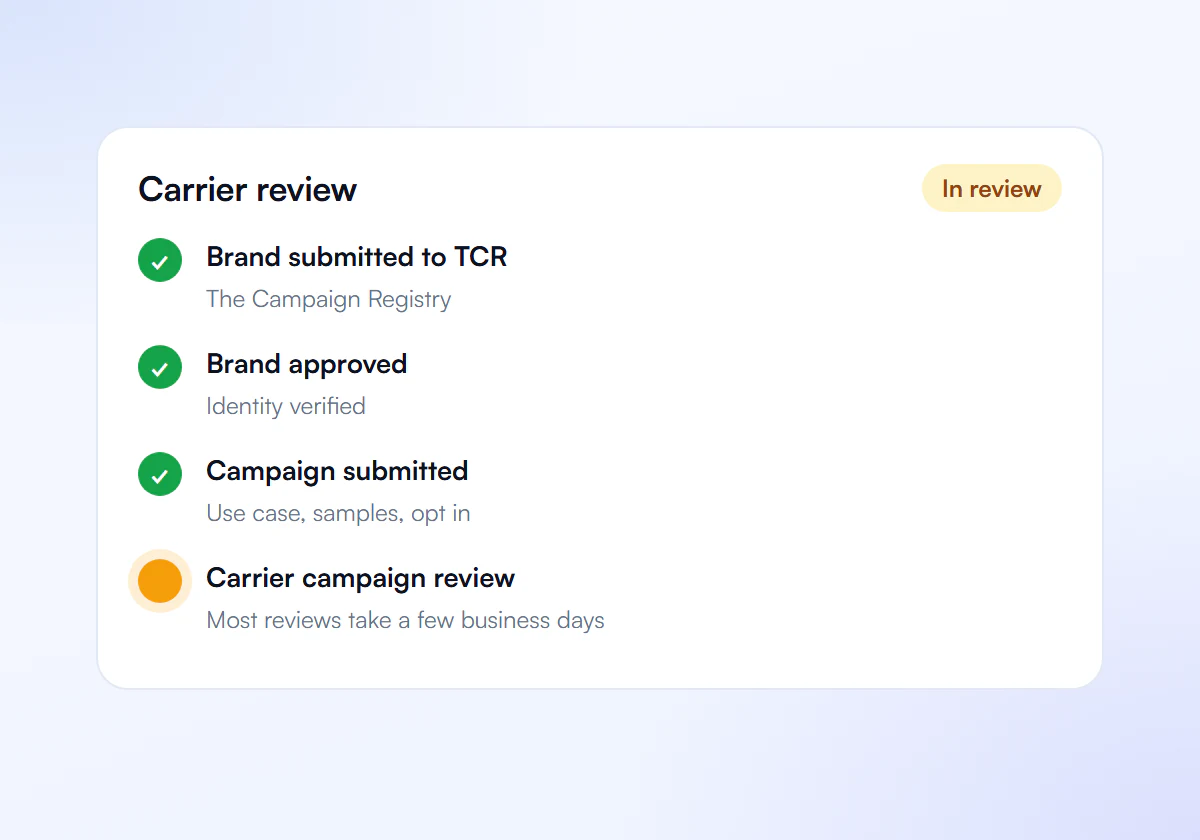
Carrier Review
Carriers review your campaign. Most reviews take a few business days.
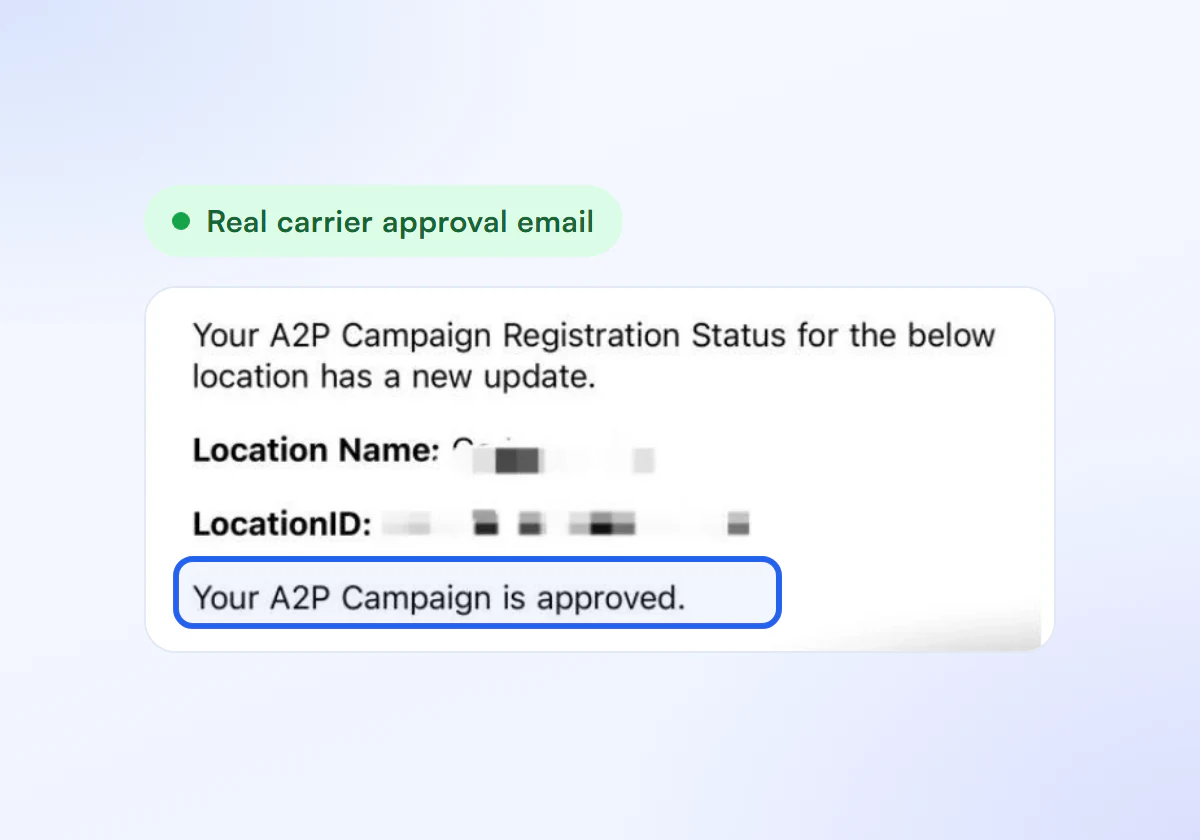
Get Approved
Link your numbers and start sending compliant texts.
Compliant Registration, Flat Price
We build a compliant opt-in flow and handle your registration for a flat fee. One business costs $50, paid once, and a pack of ten costs $399, or $39.90 each. Rejection fixes and resubmission are part of the price. Your SMS provider charges registration and carrier fees separately.
Single Verification
$50
per verification, paid once
For one business that needs carrier approval to text its customers.
- Brand registration with The Campaign Registry
- Campaign registration with use case and sample messages
- Opt in, privacy policy and STOP and HELP review
- Fixes and resubmission until approved
10 Verification Pack
$399
10 verifications, $39.90 each
For agencies and multi location businesses verifying several brands. Just $39.90 per verification.
- Everything in Single Verification
- 10 verifications for your clients or locations
- $39.90 each instead of $50, you save $101
- Fixes and resubmission until each one is approved
Your SMS provider charges registration and carrier fees separately.
Frequently Asked Questions
Is one-to-one consent still required for texting?
No. The 11th Circuit Court of Appeals vacated the FCC’s one-to-one consent rule on January 24, 2025. Pages that say it still applies are out of date. Prior express written consent for marketing texts still applies.
What hours can I send marketing texts?
Federally, 8 a.m. to 9 p.m. in the recipient’s local time. Florida and Oklahoma are stricter at 8 a.m. to 8 p.m., so many businesses use 8 a.m. to 8 p.m. everywhere to stay safe.
When does the revoke-all rule take effect?
The FCC delayed it to January 31, 2027, and is reconsidering it. Honoring opt-outs quickly and by any reasonable method is good practice in the meantime.
Is this page legal advice?
No. It summarizes rules as reported by legal sources and state-law trackers as of October 2026. Confirm with counsel for your business and the states you text into.
Want a Compliant Setup?
Tell us how you text and we prepare a compliant flow.
